
Between 2021 and July 2026, Portuguese public entities contracted 612 sanitation studies and design projects, from 208 different bodies. One hundred and forty-five of those contracts mention a treatment plant — and a pattern emerges: where the contract object says what kind of intervention is intended, it refers to existing plants three times more often than to new ones, 55 against 16. Refurbish, rehabilitate, expand. In the remaining 80, the object does not say enough to tell.
It makes sense. The installed base is twenty or thirty years old, was sized for a population and a load that have since changed, and is now reaching the point where equipment needs replacing just as discharge requirements tighten.
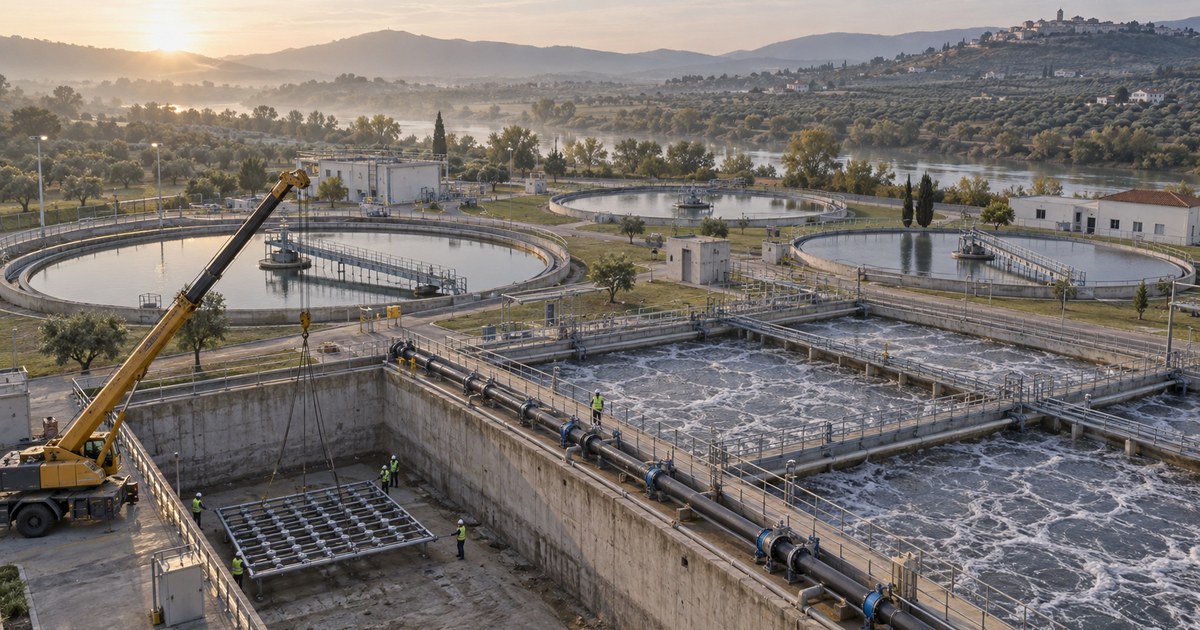
Retrofitting a treatment plant while it keeps running is, technically, harder than building a new one. There are five decisions taken in the first weeks of design, when they still cost little, and they condition twenty years of operation.
1. What flow is actually being treated
The first temptation is to size for the population served. It is almost always wrong.
The flow that reaches a treatment plant rarely matches what the network was meant to carry. In decades-old networks, a substantial part of what comes in is water that should not be there — groundwater infiltrating through joints and cracks, and rainwater from cross-connections nobody ever recorded. On rainy days that share can multiply the inflow.
Sizing the retrofit without first measuring what really arrives, and under what conditions, is sizing for a number that does not exist. A flow-measurement campaign in dry and wet weather costs a fraction of the design and changes it completely.
The question to ask: is the design based on measured flows, or on flows calculated from population?
2. What happens with the plant in service
A treatment plant does not stop. Effluent keeps arriving every day while the works go on, and the discharge licence keeps applying.
This is not a site-logistics detail — it is a design constraint. It determines whether the retrofit is phased, whether a temporary by-pass is needed, whether there is interim treatment, and in what order the lines are worked on. A design that does not resolve the phasing is pushing the problem onto the contractor, who will solve it in whatever way suits them best — and submit the variations.
The question to ask: does the design define the sequence of intervention with the plant in service, or does it defer that to the contractor’s works programme?
3. The inlet works, where everything starts to go wrong
It is the least conspicuous part of the plant and the one that most compromises the rest. Screening, grit removal, grease removal: if it fails here, grit ends up in the digesters, wears out pumps, takes up useful volume and forces clean-outs nobody budgeted for.
Among the published contracts there are designs dedicated exclusively to the inlet works and to grit chambers, at plants that had already been retrofitted. They are few — two, out of 612 — but each one is a plant where pre-treatment was left out the first time round.
The question to ask: does the retrofit include pre-treatment, or does it assume the existing one can take the new load?
4. Where the energy goes
Aeration is, in most activated-sludge plants, the largest single consumer — typically the biggest share of the plant’s energy consumption. It is also where a retrofit can gain the most, because diffusion and control technology has changed a great deal since most of these plants were built.
Energy efficiency has stopped being an extra and become one of the reasons for retrofitting. There is dedicated procurement for blower replacement and for energy-balance studies at existing plants — rare in the objects of the published contracts, which says more about what fits in a title than about what gets bought.
But there is a right order: first correct the flow and the load, then size the aeration. Optimising the aeration of a plant that treats infiltration water is buying efficiency to treat what should not be there.
The question to ask: does the design quantify specific consumption per cubic metre treated, before and after?
5. Where the treated effluent goes
For decades the answer was “to the watercourse”. It is no longer the only one.
Treated wastewater now has its own framework as water for reuse — irrigation of green spaces, street washing, industrial uses, and internal uses within the plant itself. There are design contracts for pumping and conveyance infrastructure for reclaimed water from existing plants — five, out of 612.
This changes the design: it requires different treatment quality depending on the end use, a dedicated distribution network, and specific licensing. Deciding later means redoing.
The question to ask: does the design assess reuse as an option, even if only to reject it with reasons?
The point
None of these five decisions belongs to the designer. They belong to the client — and the designer works within what the terms of reference define.
When they are not taken explicitly, they are taken by default. And the default always costs the same: what comes out cheaper in design comes out dearer in operation, for the following twenty years.
IdroAM Water Engineering prepares and reviews retrofit designs for wastewater treatment plants. If you are preparing terms of reference, talk to us.


